

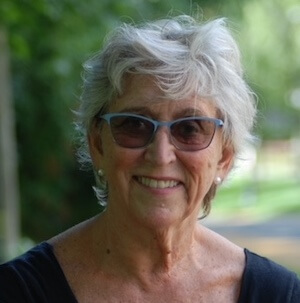
Judy Foreman is a former Boston Globe health columnist and the author of three works of nonfiction from Oxford University Press. In 2022, she published her first novel, CRISPR’d, from Skyhorse Publishing. A Wellesley College grad (Phi Beta Kappa), she spent three years as a Peace Corps Volunteer in Brazil and has a master’s from the Harvard Graduate School of Education. She was a Lecturer on Medicine at Harvard Medical School, a Fellow in Medical Ethics, also at Harvard Medical School, a Knight Science Fellow at MIT, and a Senior Fellow at the Schuster Institute for Investigative Journalism at Brandeis University. She has won more than fifty journalism awards, including a George Foster Peabody Award and a Science in Society award from the National Association of Science Writers. She lives outside of Boston with her husband.
about THE SCALLOP PLOT
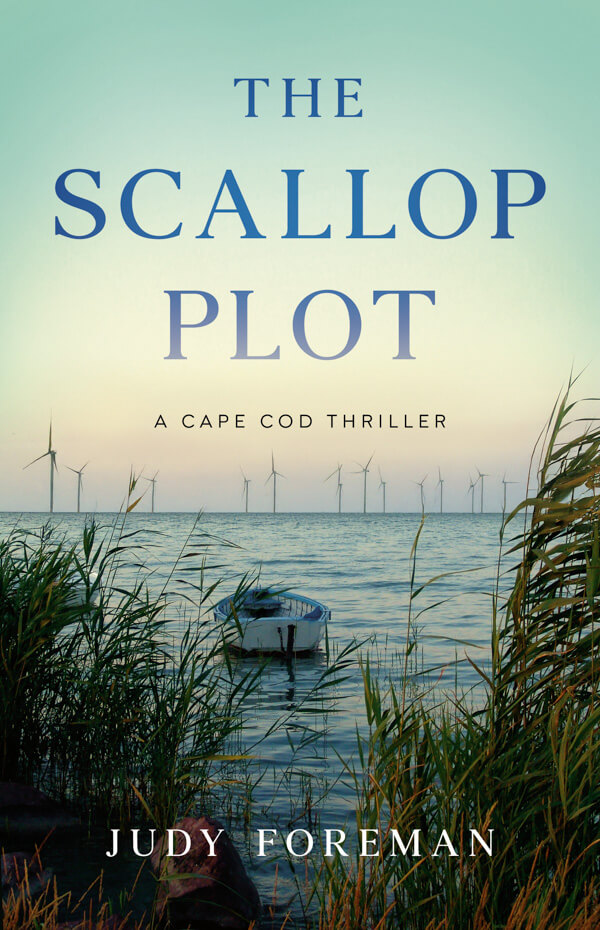
In this thriller, star investigative reporter Samantha Fuller joins a feisty Cape Cod fisherwoman to foil a wind farm developer’s evil plot to poison precious ocean scallop beds—and finds herself facing off against right-wing climate deniers.
In Provincetown, MA, feisty scallop fisherwoman Isabella Ferreira goes up against a sleazy wind farm developer, Olaf Svensson, who wants to install wind turbines in the ocean right off the coast of Cape Cod.
At a nearby scallop hatchery, marine biologists Leif and Astrid Borgen are already using the new gene editing technique CRISPR to insert a growth hormone gene into scallop embryos to make them bigger and thus more profitable—all of which is legal. But unbeknownst to the hatchery owner, Svensson is also paying the pair to insert another gene—one that causes PSP, paralytic shellfish poisoning. If this works, no one will ever eat scallops from this site again, thus freeing it up for Svensson’s turbines.
Enter Pulitzer Prize–winning Boston Times reporter Samantha Fuller. Together with Isabella, she slowly uncovers Svensson’s deadly plot—but not before hundreds of people die. Along the way, love blossoms, tragedies occur, and the subtleties of the pro- and anti-wind power groups are exposed.
about LET THE MORE LOVING ONE BE ME
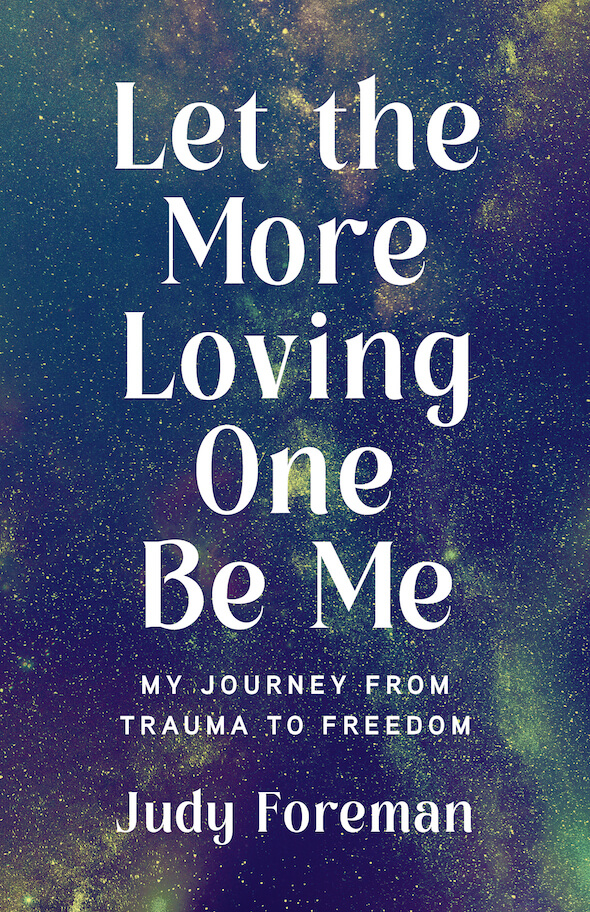
In this compelling tale, Judy Foreman reveals the terror she felt every night as a girl as she lay in bed frozen in dread, listening for her father’s footsteps coming down the hall. She recalls his mostly naked body, his stale smell, his silhouette in the bedroom doorway. Worse, in some ways, was her mother’s denial—her insistence that this man was wonderful, her refusal to acknowledge his drinking or his rage. It wasn’t until Foreman spent a high school summer as an exchange student with a Danish family that she began to see how unsafe her own family was; it wasn’t until she went to an all-women’s college that she realized that women had value. Ultimately, this book shows that with time and therapy, it is possible to heal from serious childhood trauma and lead a life of deep fulfillment, rewarding work and, most wonderfully, love. It is a book about the power of emotional courage to change one’s own inner and outer experience of the world, and about what matters most in life: cultivating healthy connections to other people.